What are the SEAMLESS tools?
UNLOCK INSIGHTS FROM IEPs
The features of individualized education plans (IEPs) make them difficult for non-approved personnel, like data analysts, researchers, or even other educators, to access them. We have tackled these barriers through the development of two innovative tools.
Zone Redactor
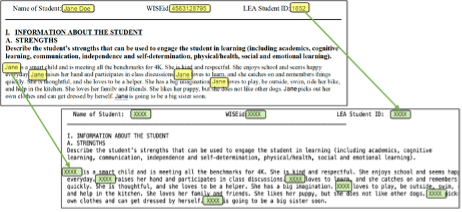
Zone Redactor efficiently redacts the sensitive information in IEPs. Our patent-pending technology uses natural language processing, large language models, and named entity recognition to de-identify protected information (names, addresses, ID numbers) from IEPs automatically and in seconds, rather than requiring researchers or school/district partners to manually redact IEPs one by one.
On average, it takes a human about 15 minutes to redact an IEP. But Zone Redactor removes all sensitive information from an IEP in 10 seconds or less. Put another way, while redacting 50 IEPs might take a human more than 12 hours, Zone Redactor can accomplish this task in less than 10 minutes.
ClassifyED
ClassifyED uses machine learning to classify these de-identified IEPs into useful categories for further analysis. ClassifyED is a new effort to help summarize open-ended IEP text into usable “chunks” of information, which can then be compiled into a data frame for further analysis in service of a variety of goals.
ClassifyED can be used to create a new coding framework from the ground up, or the system can use preexisting code descriptions to train a model. These coding schemes are then iteratively refined and validated using specific example texts. ClassifyED thus enables detailed analysis of IEP content, trends, goals, services, educational environments, and student progress without the need to manually review and individually code every IEP, which can be too time-consuming and labor-intensive to perform at scale.
ClassifyED could enable analysis that supports:
- Improving the quality and the depth of IEPs
- Evaluating the effects of special education policy and informing future policy decisions
- Improving outcomes for students with disabilities
- And more!
Together, these tools help to unlock insights from IEPs, enabling:
- Practitioners to spend less time digging through paperwork and more time focusing on improving student outcomes and program performance
- Administrators to engage in data-informed decision-making activities with parents and IEP teams throughout the year
- Researchers to establish more efficient data partnerships with schools and districts, and to more quickly analyze IEP data
- Policymakers to identify what works, where, and for whom